The short answer
Yes. Flat roofs are one of the easiest places for a sun tunnel, because the tube is short and so loses little light. The dome sits on a raised kerb that is weathered into the roof covering. The main checks are the condition of the covering, the build-up of the roof and the depth of the ceiling void.
Why flat roofs suit sun tunnels
A flat roof is only a hand's depth or so above the ceiling it covers. The tube from dome to diffuser is therefore very short, and a short tube holds on to nearly all the light it collects. For a kitchen extension, a rear utility room or a bungalow's flat-roofed bathroom, that makes a tunnel an efficient way to brighten a space with no window on the right wall.
Because there is no sloping roof to cross, there are also no rafters at an angle and no loft to climb through. The work is more compact than on a pitched roof.
How the dome is set on the roof
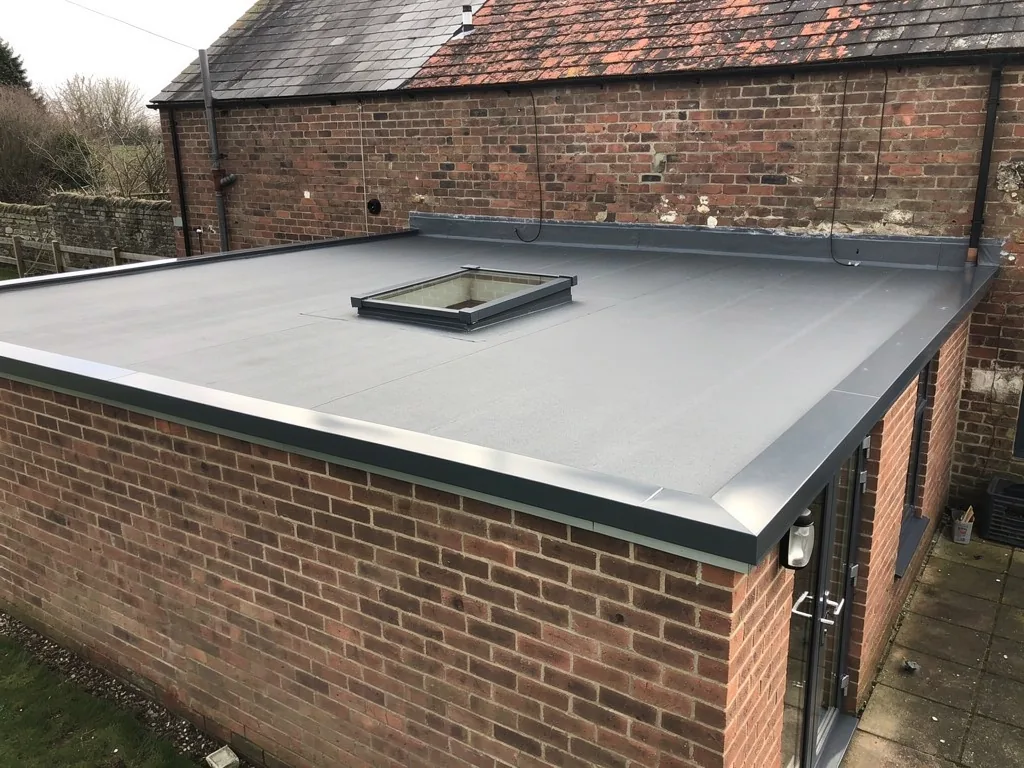
A flat-roof tunnel does not sit flush on the surface. It stands on a kerb, a low insulated upstand, usually at least 150mm above the finished roof, with the dome fixed on top of it. The upstand lifts the joint above standing water so rain is carried away from the opening instead of towards it.
The roof covering is then taken up the side of the kerb and finished beneath the dome's flashing. That detail is where most of the care goes. It decides whether the roof stays dry over the years, and it is hidden once the job is done, which is why we photograph it as it goes and hand you the pictures when we finish.
What gets checked before we quote
On a flat roof
- The covering: felt, rubber or another membrane, and whether it is sound around the chosen spot
- The build-up: how thick the insulation and decking are, and where the joists run
- The ceiling void: the space between roof and ceiling the tube has to cross
- The fall of the roof, so the kerb does not hold back the water
- Any services running above the ceiling in that position
A tunnel cut into a roof covering that is already tired is a poor use of money. If the surface needs renewing, say so at the survey, so that the tunnel can be planned with the roof rather than against it.
The ceiling void and the tube
The tube must pass between joists, so its position is set by where those joists sit. A tunnel that lands in the middle of a joist can be moved sideways, or the joist can be framed round with extra timbers. Opening joists up is structural work, so it is done with proper trimmers and checked.
The tube itself is wrapped so the ceiling stays insulated around it. Our answer on condensation and sun tunnels explains why that matters.
Flat roof or something larger
If you want a lot of light from a flat roof, a tunnel is not the only option. A flat rooflight lets in far more, and it can be fixed or opening. Our page on flat roof rooflights covers them. A tunnel still has a place in the same house, in the small rooms that a big rooflight would not suit.
Permissions and paperwork
Houses usually have permitted development rights for rooflights, within certain height and position conditions, but flats and maisonettes do not, and listed buildings need consent. Our skylight planning permission guide goes through the rules. Cutting a new opening also needs Building Regulations approval, which we arrange where the work is notifiable.
What happens on the day
The room below is covered, the opening is cut, the kerb and dome are set and weathered, and the diffuser goes in last. The roof is made weathertight before we leave. The wider picture sits in the sun tunnel installation hub, and the likely duration in how long a sun tunnel takes to fit.
Roof coverings and how they are handled
Flat roofs come in several finishes. Traditional felt, single-ply membranes, rubber sheet and fibreglass all have their own way of being cut and sealed. Each of these is joined to the kerb differently, and a fitter who has worked with that exact covering will seal it better than one who has not, whatever tunnel goes in. We identify the covering at the survey, by looking at it and checking its age and condition, and plan the weathering to match it.
If the roof is shared with a roofer who laid it recently, it can be worth checking that any guarantee on the covering is not affected by a new opening. We can talk that through with you.
Choosing the spot on a flat roof
Walk the room with the roof in mind. The dome should sit clear of parapet walls and taller neighbouring roofs that would cast shade across it, and away from the lowest point of the fall, where water gathers after rain. At the survey we mark a position on the ceiling, then check it from above against the same spot on the roof.
Living with it afterwards
A flat-roof dome collects leaves and dust more readily than a sloping one, so a glance now and then keeps it bright. Debris left to sit can hold water against the kerb. A clear dome, a clear surrounding roof and a dry kerb are what keep the tunnel trouble-free.
Inside, the diffuser sits flush with the ceiling. Most people stop noticing it as a feature and simply notice that the room is brighter.
We check the roof covering and the depth of the ceiling at the free survey before quoting.
Get a free quote