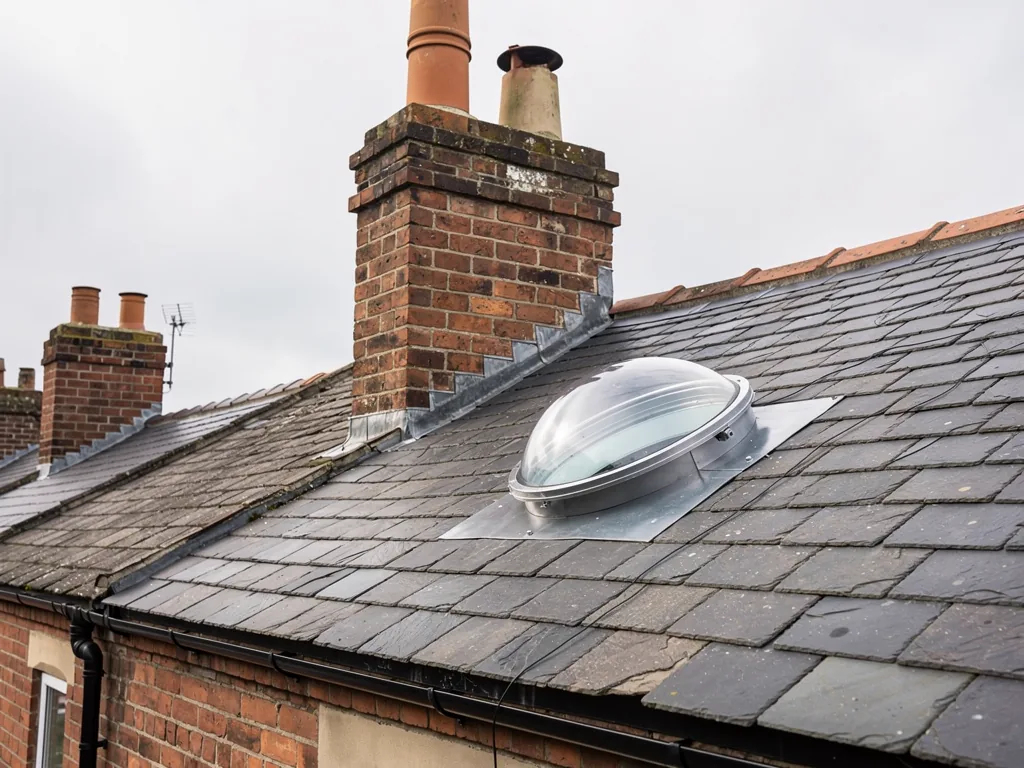
Between the dome on your roof and the diffuser on your ceiling sits a tube, and there are two kinds. Rigid tube comes as straight metal sections, joined end to end. Flexible tube is a ribbed, foil-lined sleeve that bends. Both carry daylight, and both are used in homes across York, but they behave differently.
Which one goes in is decided by the loft above your room and not by a catalogue. A rigid tube is a mirrored metal pipe and a flexible one is a ribbed, foil-lined hose, and that single difference changes how each handles bends.
How rigid tube works
Rigid tube is made of aluminium sections with a highly polished, mirror-bright lining. The sections slide into one another and are taped at each joint. Where the route has to turn, a fixed elbow is added, and some elbows can be adjusted a little to suit the angle between the roof and the ceiling.
Because the lining is smooth, daylight bounces down it with little loss. A straight rigid run is the best carrier of light there is, which is why it is our first choice wherever the loft allows it.
How flexible tube works
Flexible tube is built like a concertina. It can be stretched, bent and curved, so it follows a route that a straight section would never manage. It is lighter and quicker to fit, and it can slip past a pipe, a tank or a stray timber.
The price of that freedom is light. The ribs in the lining scatter some of the daylight on every pass, so a flexible tube delivers less than a rigid one of the same length and diameter. In a tight loft that is a fair trade, because a tunnel that fits beats a better tube that does not.
Side by side
| Light carried | Rigid carries more over the same distance |
|---|---|
| Straight runs | Rigid suits them best |
| Crowded lofts | Flexible threads round pipes, tanks and timbers |
| Joints to seal | Rigid has more, flexible has fewer |
| Time in the loft | Flexible is usually quicker in a cramped space |
| Insulation | Both are wrapped where they cross the cold loft |
What the route tells us
We choose the tube after we have looked at the loft. If the dome and the diffuser line up, or can be made to with a single angled elbow, rigid is almost always right. If the line meets a water tank, a chimney breast or a run of pipes, we plan a way round, and flexible may be part of it.
It helps to see the loft as a set of gaps. The tube must pass between rafters at the top and ceiling joists below, and we do not cut either to make room. So the route follows the gaps, and the tube is then picked to fit them.
Mixed runs
Often the best answer is both. A rigid length goes down from the dome, where the line is clean, and a short flexible section takes over to pass an obstruction, then rigid again to reach the ceiling. You keep most of the light of a rigid run and the freedom of a flexible one.
We show this on the quote as separate lines, so you can see which length is which. If you would like to understand the effect on price, our guide to sun tunnel cost, fitted explains where tube choice appears in the figures.
How tube choice affects the light
Three things control how much daylight reaches the diffuser: the diameter, the length and the number of bends. Rigid tube is kinder on all three. But a tube that is too long, in either kind, will lose a lot on its way down, and the room will feel it.
That is why we plan the shortest sensible route and avoid kinks. A sagging flexible tube, or one pulled tight round a corner, can lose more than a well-supported one that follows a gentle curve. Our guide on how much light a sun tunnel gives explains the other factors, such as roof direction and shading.
Keeping the tube warm and dry
Whichever tube goes in, it passes through the cold air of the loft above a warmer house. Warm, damp air meeting a cold surface leaves droplets, so the tube is wrapped in insulation through the loft and the joints are taped. The diffuser is sealed to the ceiling so moist air from the room cannot climb into the run.
Flexible tube has a second consideration. Its ribs can collect dust if the run is left loose, so we support it to keep the line clean and taut. The question of damp is covered in do sun tunnels cause condensation.
Pitched roofs and flat roofs
On a flat roof the tube is short, because the ceiling and the roof surface are only a joist depth apart. Here the choice between rigid and flexible hardly matters, and a short rigid piece is usual. The things that count on a flat roof are the kerb and the covering.
Under a pitched roof the run can be long, and the choice matters more. The more loft there is between slates and ceiling, the more it pays to find a straight path. If your landing sits below a steep, tall loft, you may want to read whether a sun tunnel can go through a loft before the survey.
Loft types and what they mean for the tube
An open, boarded loft with plenty of height is the easy case. You can see the whole route, move about freely, and fit long rigid lengths without fuss. A low, cut-up roof space is harder. Here the sections of rigid tube are awkward to carry and join, and a flexible length may be the only practical way to get from the roof to the ceiling.
A converted loft is different again. If the roof space has been turned into a room, the tube cannot cross it, and the tunnel is only possible for a room below the conversion if a route runs past the new room's walls. In many cases the answer is to look at a roof window instead.
Older houses bring their own surprises. Chimney stacks, old water tanks and bracing timbers are common in the roofs of Victorian and Edwardian homes. Spotting them from the hatch is part of the survey, and we plot a route that leaves them where they are.
Common worries, answered plainly
People sometimes ask whether flexible tube is a cheaper, lesser option that the installer reaches for to save time. It is not. It is a different tool for a different loft, and the quote says why it is there. A flexible section placed where a rigid one cannot go does more good than a rigid one forced through a bend.
Another worry is noise or rattle. Neither type makes a sound once fitted, because both are fixed and supported along the run. A third is fire safety. Tubes that pass through a ceiling are fitted and sealed with that in mind, and the details are covered in the product's instructions, which we follow and hand over.
Signs a rigid run will suit
- The dome and diffuser line up, or nearly so
- The loft is open and easy to move about in
- No tank, chimney or pipework sits on the line
- One angled elbow is enough to join the two
If the answer to most of those is no, flexible tube or a mixed run is probably where the survey ends up.
Diameter, length and what they do together
The tube choice does not stand alone. A wide, straight rigid tube will carry far more light than a narrow, long flexible one. When the loft limits the width, because the gap between rafters is small, we say so and talk through what that means for the room. In some houses a smaller tube is all that fits, and for a small bathroom or cupboard it is quite enough.
It helps to match the tube to the room. A landing with several doors off it can use the most light it can get. A small cloakroom does not need a large circle in the ceiling.
What the day in the loft looks like
On the day, one of the team goes up into the loft with the sections and a roll of tape while another works on the roof. The loft run is laid out first, before the ceiling is cut, so every length can be checked against the line marked at the survey. Rigid sections are fitted from the top down, each pushed into the one below and taped at the joint.
A flexible length is stretched out and supported so it holds its line. Then the whole run is wrapped in insulation, with the wrap overlapped and taped so it forms a continuous sleeve. Before the loft is closed, we look along the finished tube from the ceiling end, which shows any kink or sag straight away.
Photographs are taken of the loft work before it is covered over, and they go into your handover pack. The hidden part of the job should be as well done as the diffuser you will see.
Light and colour inside the tube
The lining is what makes a tube work. A mirror-bright surface sends most of the daylight on its way, so even a long run can deliver a useful glow. Flexible tubes have a foil lining with ridges, which scatters more, and some ranges offer a smoother liner than others.
Dust is the one enemy of the lining, which is another reason the joints are taped, since a closed tube stays bright for far longer than one with gaps. A tube that is sealed at the top by the dome and at the bottom by the diffuser keeps its inside clean without any attention from you. The light reaching the diffuser is neutral and white. Some people worry it will look yellow or cold. In practice it looks like the daylight outside, softened by the frosted disc, and it takes on the warmth of the ceiling and walls of the room it falls into.
Making the choice with us
You do not have to settle this alone. At the free survey we go into the loft, trace the route and tell you which tube we would use and why. The decision then appears as a line on the written quote, and the fitting plan for each day shows when that part of the work happens.
Bring these to the survey
- The room you want lit, and the spot you have in mind on the ceiling
- Access to the loft hatch, cleared if possible
- Any pipework or cabling you already know sits above the room
For the rest of the job, see sun tunnel installation, and use the quote form to arrange your visit.