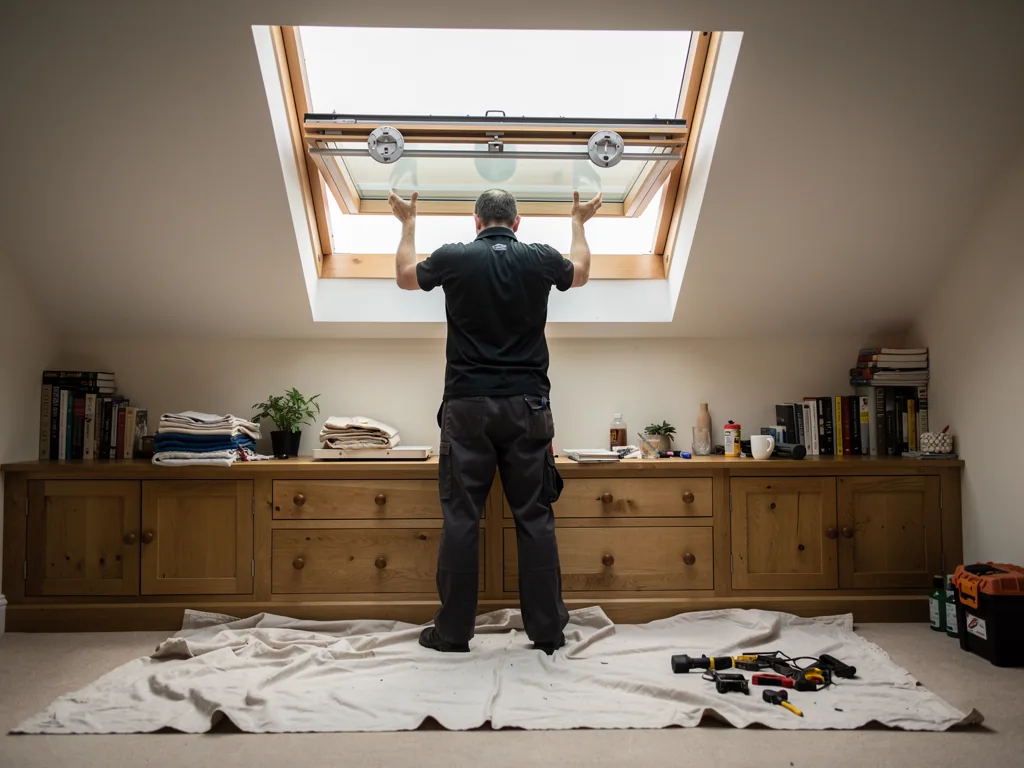
Taking out an old skylight and putting in a new one sounds like a straight swap. In most houses it is closer to a small renovation of one corner of the roof. The opening already exists, which saves cutting timber, but everything around it was built to suit the old unit, and the old unit is rarely the same size, shape or standard as the one that goes in.
This guide explains how a replacement is judged and carried out, from the first look at the roof to the finished reveal. It is written for people living in the house while it happens, so it keeps coming back to what you will see and what you will need to decide. It sits within our skylight and rooflight guides.
Start with what you actually have
Skylights in older York houses come in several kinds. There are timber roof windows from the loft conversions of earlier decades, plastic domes on flat extension roofs, pitched-roof rooflights fixed in place since the house was built, and the odd small glazed hatch that nobody remembers fitting. Each is replaced differently, so the survey begins by working out which one you have.
The frame, the glass and the roof around them are looked at as three separate things. A frame can be sound while the glass has gone cloudy. The glass can be fine while the surrounding roof covering has aged. Often all three are tired together, and the answer is a whole new unit. We would rather tell you which of those situations you are in than assume the biggest job.
Glass only, or the whole thing
When the only problem is mist or condensation trapped between the panes, the sealed glass unit has failed and the frame may be perfectly good. Swapping just the unit is a smaller job, with a smaller bill, and no new opening or flashing is involved. Our guide to the sealed unit or whole rooflight choice sets out how to tell the two cases apart.
Replacing the whole skylight, frame and glass together, is a different job in the eyes of the rules. It counts as a controlled fitting, so it is notifiable under the Building Regulations, and we arrange that notification. A sealed unit on its own is not notifiable. Keep that in mind when comparing quotes, because a glass-only price and a full replacement price are answering different questions.
| Sealed unit only | Frame stays, new glass goes in, no Building Control notification |
|---|---|
| Whole skylight | Frame and glass both replaced, notifiable as a controlled fitting |
| Different size | Opening is altered, which brings structure into the job as well |
| Different position | A new opening, with planning and structural questions of its own |
Same size or a new size
The simplest whole replacement puts a new unit into the exact opening the old one occupied. The trimmers and rafters are already there, and the work is mostly about removing the old flashing and kerb, checking the timber and building the new weathering around the new frame.
It is tempting to enlarge a window while the scaffold is up. That can be a good idea, particularly if the old one was small for the room, but it changes the job. A wider opening may need a rafter cut and a new trimmer to carry it, and a taller one moves the flashing detail. Structure and thermal performance are then assessed as a new opening. If you are curious about sizing, the types of rooflight guide explains how each style relates to the room.
What the old skylight is hiding
The unseen parts are where an old skylight tells you the most. Once the unit is out, the trimmers around the opening are visible, along with the insulation, the membrane under the roof covering and the timber that has sat close to the glass for years.
Older installations often have gaps in the insulation around the frame, a membrane that stops short of the edge, or a lining board that is damp at the lower corners. None of this is a surprise to us, but it does mean the quote cannot be a flat figure for the unit alone. We list the hidden work as its own lines, and photograph it as it is exposed and again when it is closed, so you see what was found and what was done.
The roof around the opening
On a pitched roof, the slates or tiles beside and below an old window have usually been disturbed and re-laid at least once. The new flashing kit has to lap properly with the covering, so we strip back a small area, lay it correctly and put the covering back in the right order. If the surrounding slates are brittle, we say so before starting, not halfway through.
On a flat roof, the covering has to be lifted and reformed up the new upstand. A flat roof in its last years is hard to join to cleanly, so the survey asks how old it is and what state it is in. A new rooflight set into worn roofing can create a weak line along its edge. Where the covering is tired, we price the option of re-covering the surrounding area in the same visit, and you can say yes or no.
A flat rooflight or lantern is carried on an insulated kerb, normally 150mm or more above the finished roof, so an old low kerb often has to be rebuilt. The flat roof rooflights page covers what that involves.
Replacing a roof window
Roof windows in pitched roofs, including VELUX windows, are the most common old skylight to be replaced. The VELUX size code on the data plate gives the width as the letter and the height as the digits, and the plate is visible on the frame when the window is open. Reading it tells us whether a current model fits the existing opening, and it is the first thing to check if the original is still a recognisable make.
Makers change their sizes over time, so a window from decades ago may not have an exact modern equivalent. We can often match it with a slightly different frame and an adapter flashing, or we can resize the opening slightly. We explain both choices and what each does to the interior finish. Our own page on replacing an old VELUX window goes into this more closely.
Replacing a plastic dome or old flat rooflight
Many flat extensions from earlier decades carry a plastic dome, set on a thin moulded upstand. They let in light, but they lose heat and they yellow and craze over time. Replacing one with a flat glass rooflight brings a different look and a better thermal performance, and the replacement needs a taller, insulated kerb in place of the thin moulded one.
The new unit may also be a different shape from the old one. A circular dome becoming a rectangular glass rooflight, for instance, needs a rectangular opening cut. Our guide to replacing a polycarbonate rooflight with glass goes through the steps and the points to check first.
What will it be like at home
A replacement is shorter and tidier than a new opening, but it still opens the roof. First we cover the floors, stairs and furniture, and we screen off the space under the skylight where we can. The old unit comes out carefully, and each evening the opening is sealed against the weather before we leave, so you never sleep under a gap.
Work on the ceiling lining is the dustiest stage. The old reveal is often cut back, and the new one is boarded and plastered. We vacuum as we go, remove waste daily and leave the room ready for paint. If you want a room decorated afterwards, mention it at the survey and it appears as a separate line.
A typical replacement, day by day
- Protect and strip outCover the floors and furniture, take out the old unit and clear the opening.
- Check and rebuildInspect the timber and trimmers, then lay the new membrane, insulation and upstand.
- Fit and weatherSet the new unit, dress the flashings or roof covering and make everything watertight.
- Finish insideLine and plaster the reveal, tidy up and walk you through the handover.
Matching colour, finish and look
A new skylight does not have to copy the old one. Frames come in white, grey, black and other colours, and the outer finish is chosen separately from the inside. On a slate roof a dark grey frame sits quietly in the slope, while a white lining indoors keeps the room bright. If the old window was pine, you can keep that look indoors or change it.
Blinds are worth deciding now. A blind made for the exact window fits its side channels and hides no gaps, and it is simpler to fit while the reveal is open than to add once the room is decorated. Say at the survey what the room is used for, and the blind, opener and glass can be chosen together.
Planning and the rules
Swapping a skylight for another one of similar size and position is not normally something a council needs to know about, but the position of the new unit still has to meet the permitted development conditions. Rooflights on houses are usually permitted development when they project no more than 150mm from the roof plane and stay below the top of the roof. A unit on a side slope needs frosted glass that is fixed shut, except where its opening section is over 1.7m from the floor.
Flats and maisonettes have no permitted development rights for this and need planning permission. Listed buildings need listed building consent, and a conservation area may have an Article 4 direction on particular streets. The council confirms which applies. All of this is set out on the skylight planning permission page, and the building regulations answer covers the notification side.
Cost, timing and what to ask
Replacement cost depends on whether it is glass only or the whole unit, whether the opening changes, how much of the surrounding roof needs attention and how much finishing you want inside. Our skylight cost guide explains how the pieces of a quote add up.
Most single replacements are measured in days rather than weeks, and winter is not usually a barrier, since the roof is closed again every evening. For more on timing, see how long it takes to fit a skylight.
Questions worth asking any installer:
- Is only the glass being replaced, or the frame as well?
- What happens to the kerb or flashing round the old unit?
- Will the new unit match the old opening, and if not, what changes?
- Is the hidden work photographed, and do I receive the photos?
- Who arranges Building Control, and is the guarantee in writing?
The survey is free and ends with a written quote, one cost per line. If you would like one, use the form below.