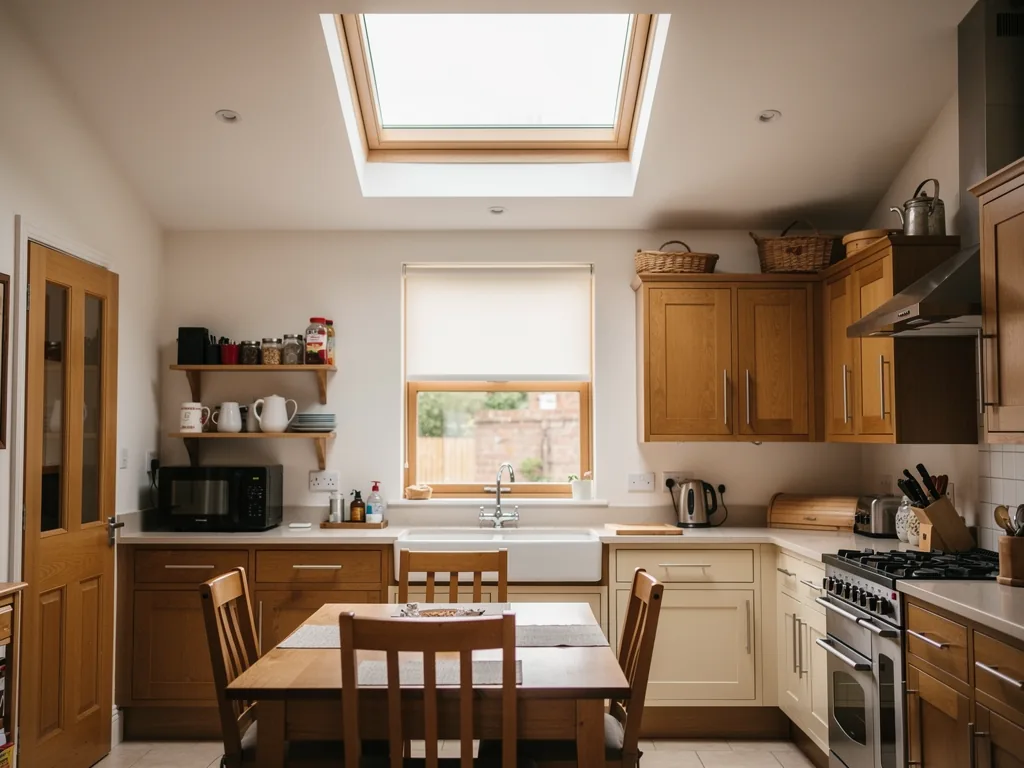
Look up at the flat roof of an older bungalow, a kitchen extension or a garage conversion and there is a fair chance a plastic dome or a clouded sheet of polycarbonate is looking back. They were cheap to buy, light to carry and quick to fit, and for a while they did their job. Many have now turned yellow, cracked at the corners and begun to let the cold in.
This guide explains what replacing one with a glass rooflight involves. It covers why reglazing is not an option, what has to happen to the kerb, how the new rooflight is chosen and what the rules say. It is written for someone living in the house, with the room below in everyday use.
Why plastic is replaced, not reglazed
A glass rooflight has a sealed unit that can be lifted out and swapped. A polycarbonate dome or sheet has nothing of the kind. The plastic is the rooflight, and when it has gone, there is no inner part to renew.
Sunlight is what does the harm. Over time ultraviolet light yellows the plastic, makes it brittle and roughens the surface, so less light comes through and the surface starts to crack. A dome that has done this cannot be cleaned back to clear. Failed glass units and failed plastic are two different problems, both covered under misted and failed rooflights.
How plastic rooflights show their age
The signs are mostly visible from below, and they tend to arrive together. You will usually notice several of these before you notice any one.
A plastic rooflight at the end of its life
- A yellow or brown tint, most obvious against a white ceiling
- A rough, chalky surface that no longer washes clean
- Fine cracks spreading out from the fixings, or a split along an edge
- Condensation that runs down the underside on a cold morning
- A cold downdraught under the dome in winter
The page on signs a rooflight has failed sets these beside the symptoms of glass units.
Why so many rooflights were plastic in the first place
Plastic domes were a sensible choice when they went in. They were light enough for a small flat roof to carry, they came in standard sizes and they could be fitted by one or two people in an afternoon. For a garage or a lean-to extension that was all that was asked of them.
What nobody planned for was the room below becoming a kitchen, a utility room or a study. A rooflight chosen for a store is the wrong one for a space that is lived in, and that is often the real reason people look to replace one.
What plastic costs the room in warmth and light
Polycarbonate, particularly in a single skin or a thin twin-wall sheet, insulates poorly. A dome over a bungalow kitchen makes the room cooler in winter, and warmer on a summer afternoon, than the same opening under glass would.
Light is the other loss. New polycarbonate can be clear, but old polycarbonate cuts a good deal of what a rooflight is for. People are often surprised by how bright the room becomes after the swap, because the dimming had come on so gradually that nobody noticed.
The kerb under the new rooflight stays out of sight
Plastic domes sit on a kerb, usually a box of timber upstand covered in the same felt as the roof. Many were built low and with no insulation, because the dome never needed more. That kerb is the first thing we examine, because a new glass rooflight sits on it for decades.
A glass flat rooflight needs an insulated upstand, with its top 150mm or more above the finished roof. Where the old kerb falls short, it is rebuilt or raised. Timber is checked for rot, rigid insulation is added, and the roof covering is dressed up and over it. We photograph that hidden work, and the photographs are given to you at handover.

Choosing the glass rooflight
With the old dome gone, the opening is a chance to choose what suits the room. A fixed glass rooflight is the simplest and the cheapest route, and an opening one gives ventilation, which is welcome in a kitchen or a bathroom.
| Fixed or opening | Opening gives fresh air; fixed keeps the build simpler |
|---|---|
| Glass type | Double glazed, low-emissivity, with a laminated inner pane for overhead safety |
| Solar control | Useful on a south or west roof that overheats |
| Frame finish | White, grey or a colour to suit the roof and the room |
Sizes are usually matched to the old kerb, but they do not have to be. If the room would gain from a larger or differently shaped opening, that is a bigger job, with structural work, and we say so at the survey.
What the swap looks like, day by day
Because the roof is open while the old plastic is out, the order of work matters. The new rooflight is made ready before the old one is lifted, and the roof is sheeted over and made safe each night.
A typical plastic-to-glass swap
- Protect the roomFloors, stairs and furniture covered, the work area screened where possible.
- Remove the old domePlastic lifted out, kerb opened up and checked.
- Build and insulateUpstand raised or rebuilt, insulated, and the membrane dressed up it.
- Fit the glassNew rooflight set and weathered in, then the reveal finished below.
The time depends on what the kerb needs, and the written plan tells you how many days to expect before the work begins.
Getting glass onto the roof
Glass weighs far more than plastic, and a glass rooflight, with its frame, is a good deal heavier than the dome it replaces. That changes how the job is carried out. Lifting a large unit onto a flat roof calls for a safe route, enough people and sometimes a tower or scaffold.
This is surveyed beforehand, and the access plan is written into the quote. The roof structure matters too: we look at whether the joists around the opening are sound before a heavier rooflight is set on them. Our answer on scaffolding to replace a rooflight goes into the detail.
Ventilation and condensation after the swap
Many rooms under plastic domes were damp because the dome was cold enough to collect moisture and drip. Glass in an insulated frame is warmer on the inside, so that drip largely stops. A kitchen or bathroom still makes steam, though, and an opening rooflight or an extractor fan helps to clear it.
If the room has had a persistent condensation problem, mention it at the survey. It may come from the rooflight, from the walls or from how the room is used, and the answer is not always the same.
Planning ahead for the swap
A little preparation makes the day easier. Clear the area beneath the rooflight of anything breakable, and let us know about pets or children who will be around. Tell us where the nearest power point is, and whether the garden is reachable without going through the house.
It also helps to decide on the finish inside the opening before the day, because a reveal is easiest to line and plaster while the roof work is fresh. We will go through each choice at the survey, so nothing is left to settle on the day, and you always know what the next step will be.
Handover and keeping the glass clear
At the end you are walked round the finished work and given the product details, the makers' warranties, the 10-year workmanship guarantee and the Building Control paperwork. The photographs of the hidden work come with them.
Glass needs little looking after: a wash with water and a soft brush a few times a year is enough, more often under trees. It is a good deal easier to keep clear than plastic ever was, because it does not scratch as easily or lose its clarity. Keep the gutters near the kerb clear, so that water drains away from the upstand.
Rules and paperwork
Fitting a new frame with new glass is a controlled fitting, so it has to be notified under the Building Regulations. We arrange the Building Control notification, and the paperwork is part of your handover. A glass rooflight in a flat roof extension in an existing home is expected to meet the Part L figure of 2.2 W/m²K.
Planning is usually simple for a like-for-like swap on a house, but a rooflight that stands proud of the roof by more than the permitted 150mm can change that, and flats and listed buildings follow their own rules. Our skylight planning permission guide explains the conditions, while the answer on notifying a rooflight replacement covers the regulations side.
Outbuildings, garages and the room below
Plastic rooflights turn up in more places than extensions. Garages, garden rooms, workshops, porches and old lean-to conservatories often have a dome or a sheet that nobody has looked at for a long time. These buildings may have no ceiling lining below, so the structure of the kerb is easier to see and the reveal is simpler to finish.
Where the room is a living space with a plastered ceiling, the swap needs more care inside. Dust is contained, floors are covered, and the reveal is made good afterwards so the finished opening looks as if it had always been there. Where it is a garage or store, there is less to finish, and the work can be quicker.
Light, glare and heat once the plastic has gone
Clear glass lets in more light than aged plastic, and some people find the room a little too bright in summer once the swap is done. Decide this before ordering, because it is easier to choose a glass with solar control than to add shading afterwards.
A south or west roof benefits most from solar control glass. A north roof usually does not need it. Blinds made for the rooflight can be fitted later, but they are tidier when ordered with it. The surveyor will ask which way the roof faces and how you use the room.
Cost and what to ask for
A glass rooflight with a rebuilt upstand costs more than a plastic dome did, and it is bought once rather than replaced again when the sun has finished with it. What separates one quote from another is mostly the kerb, the glass and the finish inside. We write each on its own line, and our guide to what it costs to sort a misted rooflight shows how those lines are read.
The survey is free. If you have a plastic dome that is clouded, cracked or cold, book one using the form below, and we will say what the kerb needs and show you the options in writing.