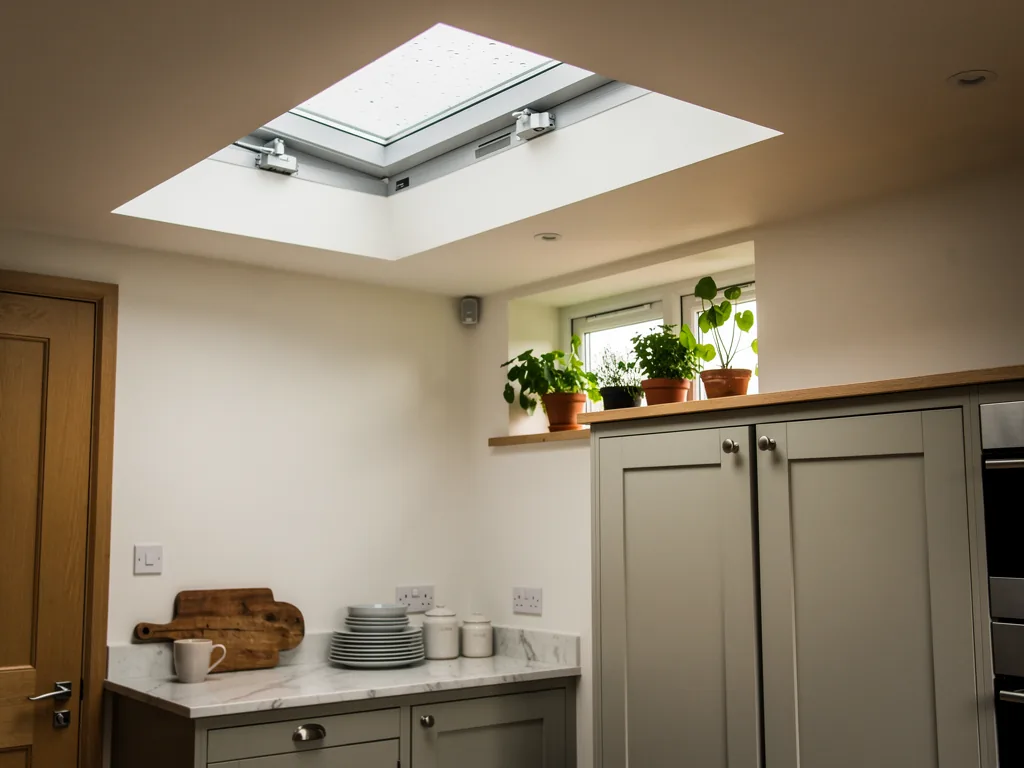
A window in a wall moves air across a room at head height. A window in the ceiling does something different: it gives the warmest, dampest air in the house a way out at the very top. That is the idea behind using an opening rooflight for ventilation, and it explains why a rooflight can make a stuffy kitchen or a hot loft bedroom feel better within minutes of being opened.
This guide explains how that works, which rooms gain the most, where the rooflight should sit and what it will not do on its own. It is written for people weighing up an opening rooflight against a fixed one or against an extractor fan, and who want to know what to expect.
Why high-level air matters
Air that has been warmed by cooking, bathing, sunshine or people breathing becomes lighter and climbs. In a room with a flat ceiling it collects under that ceiling, and in a loft room it gathers in the angle of the slope. A wall window lets some of it out, yet the warmest layer stays trapped above the top of the frame.
A rooflight opens into that layer. As the warm air leaves, cooler air is pulled in at a lower point, from an open door or a window on the other side of the house. Builders call this the stack effect, and it needs no fan. It works best when the temperature difference between the room and the outdoors is large, which is why a rooflight opened on a warm evening gives such a quick improvement.
Kitchens and extensions
A kitchen-diner with a lot of glass can overheat in summer, and cooking adds steam and smells to the mix. An opening rooflight above the cooking and eating area lets both out at ceiling height. In a modern extension with a flat roof, the rooflight is often the only high opening the room has, because the walls are mostly bifold doors or fixed glass.
Placing the rooflight matters. Directly over the hob it would catch the steam but sit in the path of any grease, so many people prefer it over the dining table or the middle of the room, with an extractor doing the close work at the cooker. Our page on flat roof rooflights shows the shapes that suit an extension.
Bathrooms and rooms with no outside wall
Many bathrooms and en-suites in older houses were squeezed into the middle of the plan or under the stairs, with no window at all. They rely on a fan, and a fan only moves the air that is near it. A roof window or a small opening rooflight above the bath or shower gives the steam a direct route out and lets the room dry afterwards, which keeps condensation off the ceiling and the walls.
A rooflight also keeps a bathroom private, since neighbours cannot look in from above. When the roof slope allows, a roof window above a bath gives light, air and a view of the sky together. Where the bathroom is on the ground floor beneath another room, a sun tunnel brings light, though a fixed one adds none of the airflow described here.
Loft rooms in summer
A room in the roof is the part of the house that heats first and cools last. Sun on the roof warms the structure through the day, and the heat collects in a sloping ceiling with nowhere to go. Opening a roof window at the top of the slope releases that air, and a window on the opposite side of the room, or a door onto the landing, completes the draught.
For a loft bedroom, the practical rule is to open the roof window in the evening as the day cools and to leave it vented overnight if the room allows. A model with a ventilation position, where the sash opens a small way and locks, makes this safe for a night, and a rain sensor can close it if the weather turns. We cover that in the page on rain sensors and controls.
Stairwells and landings
The stairwell is the chimney of an ordinary house. Warm air from every floor drifts to the top of the stairs and sits there, so the landing is often the hottest spot at the end of a sunny day. An opening rooflight above the stairs, whether a roof window on the slope or a flat rooflight over a loft stair, lets that heat out and pulls cooler air up from the ground floor.
The difficulty is reach. The rooflight is usually well out of the way, over an open stairwell where nobody can stand to turn a handle. Motor operation solves that, and a wall switch at the bottom of the stairs lets anyone open it safely. Our page on electric opening rooflights covers the options.
What an opening rooflight does not replace
An opening rooflight is a ventilation aid, and it sits alongside the fans and vents a house needs rather than taking their place. Where Building Regulations call for extract ventilation in a kitchen or a bathroom, the fan or vent stays. The rooflight adds to it on the days when you want more air.
It also depends on a path for the air to move. If every other window and door is shut, opening the rooflight alone will let some air out, but the movement will be slow. Opening a small window low down in the room makes a large difference. The rooflight is the exit and the low window is the entrance.
Damp is the other thing to keep in proportion. A rooflight helps a bathroom dry out, but it will not cure a room that is damp for another reason, such as water coming through a wall. If you have a persistent condensation problem, the survey is a good moment to describe it, because the best fix may involve the glazing, the insulation or the fan as well as the opening.
| Room | What the rooflight does | Pair it with |
|---|---|---|
| Kitchen-diner | Lets out heat and cooking steam at ceiling height | Extractor at the hob, doors or a window low down |
| Bathroom | Clears steam and dries the room | Existing extract fan |
| Loft bedroom | Releases the heat held under the slope | Window on the opposite side or the landing door |
| Stairwell | Draws warm air up and out of the house | Ground-floor window or door |
Choosing the type of opening
How the glass opens changes how much air it moves. A centre-pivot roof window turns on a bar across its middle and opens a wide gap at the top and bottom of the sash. A top-hung window pushes out from its upper edge, so the air leaves through the gap at the bottom. A flat rooflight on a hinge lifts one side to leave a gap on the other. A wide sliding unit can open the most area of all.
There is no single best style. The one that suits you depends on the roof, the room and the size of the opening. Our guide to choosing between a hinged and a sliding rooflight weighs them up room by room.
How much opening is enough
People sometimes ask for a number: how big should the opening be for a room of a given size? There is no single answer, because the result depends on the height of the room, the sun on the roof and the second opening that lets air in. A larger rooflight opened a short way can move as much air as a small one thrown wide.
A practical way to think about it is in terms of comfort rather than area. If a room is only uncomfortable on a few hot days, a modest opening on a high side of the roof will do, and a bigger one is a luxury. If the room is uncomfortable most of the summer, such as a loft bedroom facing south or an extension with a glazed gable, then a generous opening and a second one low down are worth planning from the start.
Two smaller rooflights, one near the top of the roof and one nearer the eaves, sometimes outperform one large one, because they create their own draught between them. It is a design choice we talk through at the survey, with the roof and the room in front of us.
Security, rain and heat
People who like the idea of leaving a rooflight open overnight tend to ask two things: whether it is safe, and what happens if it rains. Rooflights are well out of reach from the ground on most houses, and models with a vent position hold the sash only a short way open and locked. The other page in this set, are opening rooflights secure, goes through it in detail.
Noise is a smaller point, but worth a line. An open rooflight lets in the street, the neighbours' gardens and the weather. In a bedroom facing a busy road, you may prefer a small vent position to a wide opening, and the motor can be set to stop at that point every time.
Rain is a matter of controls. A rain sensor closes the rooflight at the first drops, which makes it practical to open it on a day that might turn. On a hot afternoon the opposite problem applies: the glass itself may warm the room, and a model with solar control glass or a blind is worth considering alongside the opening.
Planning a ventilating rooflight in a York home
Terraced houses with a dark middle room, 1930s semis with a loft conversion and bungalows with a flat-roofed extension all gain from a high opening, and each one has a likely position. In a terrace, the rooflight usually goes on the back slope or over the back addition. In a semi, it goes on the rear slope of the loft room. In a bungalow, it goes in the extension roof or on the rear pitch.
Forming a fresh opening in a roof brings Building Regulations into play, because the structure and the heat loss both change, and we make the notification when the job calls for it. Planning is a separate question, and our planning guide for skylights sets out the position for houses, flats and listed buildings. A side slope has its own rule: an opening part has to be more than 1.7m above the floor, or the glass has to be obscure and fixed.
It helps to bring a short list of habits to the survey. Which rooms get stuffy, at what time of day, and whether windows are usually left open when the house is empty. Those answers shape the position and the type of opening far better than a measurement alone.
The survey is free and covers where the opening should go, how it will be powered and how the air will move. You can ask for one with the form below.