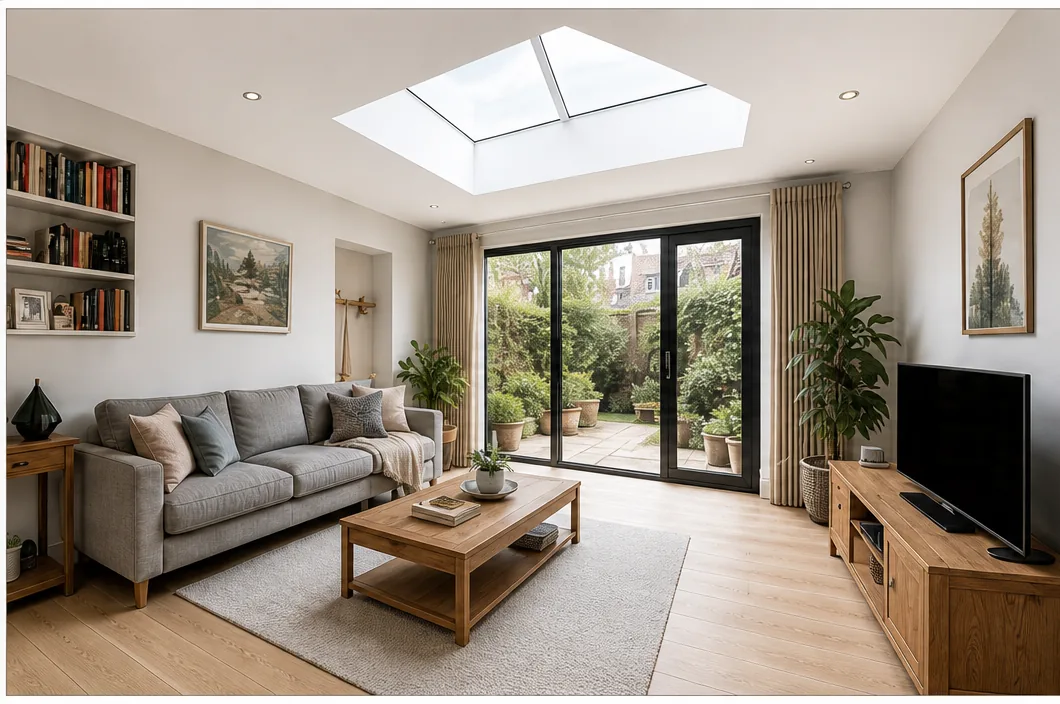
When a rooflight is going to open, there is a basic choice to make first: does the glass lift on a hinge, or does it slide? Both let air out through the roof, and both can be driven by a motor. They differ in how much opening they give, how they sit on the roof, what they need around them and what they cost.
Hinged and sliding rooflights are compared here on how they open, where they fit and what they cost to live with. It is aimed at people planning a kitchen extension, a loft room or a stairwell, who have seen both styles in a showroom or online and want to know which one fits the house they live in.
What a hinged rooflight does
A hinged rooflight has a glass lid fixed along one edge. A motor, or an arm worked by a handle, lifts the opposite edge and leaves a gap along that side. On a flat roof the lid usually rises to a set angle, then holds. On a pitched roof, roof windows work on the same principle in a different form: a top-hung sash swings out from its upper edge, and a centre-pivot sash turns on a bar across its middle.
The hinge is a proven, simple mechanism, and that is its great strength. There is one moving edge, one set of seals and one motor, and it is easy to fit to roofs of many sizes. It suits the great majority of homes, and many of the standard roof windows that makers sell are hinged for that reason.
What a sliding rooflight does
A sliding rooflight has two panes, one of which runs over the other on tracks, driven by a motor. When it opens, a wide section of roof becomes a hole, and the glass that slid back stays on the roof. The result feels less like a window and more like a roof you can pull back, which is why it suits a wide opening over a living space.
It is a larger and more specialist product, made to a chosen size, and it needs a rigid, level upstand that the tracks can sit on. The tracks have to be kept clear of leaves and grit so that the pane runs smoothly. For a room where you want a big, open feel on a warm day, there is little to match it.
Size and the amount of opening
For air, the question is how much open area the rooflight gives. A hinged lid raised to its limit leaves a wedge-shaped gap, which is generous at the open edge and nothing at the hinge. A sliding pane can uncover half the glazed area, or more on a long unit, in a clean rectangle.
On a small rooflight over a landing or a bathroom, the difference hardly matters, and a hinged window does the job. On a large rooflight over an open-plan room, a sliding unit gives a far bigger opening and a sense of being outside. It is worth being honest about how often you would use that, since a feature you slide open twice a summer may not repay its extra cost.
Light is affected as well. A hinged rooflight has a frame around a single sheet of glass, so the view of the sky is clear. A sliding unit has two panes that overlap when closed, and the join shows as a bar across the opening. Some people like the line, and others find it interrupts the sky overhead. A sample or a photograph of a finished one helps you decide.
Roof type and what the roof needs
The roof usually settles the question. A pitched roof of slate or tile is the natural home of the hinged roof window, with its flashing set into the roof covering. A sliding rooflight needs a flat or nearly flat roof with an insulated upstand, at least 150mm above the finished roof, and a structure that holds the tracks true.
On a pitched roof you can still have an opening feature rooflight, but it takes a different product and a larger structural opening. Our guide to flat roof rooflights covers the upstand, and the page on roof window installation covers the pitched side.
Ventilation in use
Hinged rooflights give good, controllable ventilation. You can open them a crack for a night vent or a few degrees for a steady draught, and the gap sits at the high side so warm air leaves easily. They can also lock in a vented position, which is useful for a bedroom.
Sliding units are better when you want a lot of air at once, for instance on a hot day in an extension with a lot of glass. They are less suited to a small night vent, since the gap is wider and harder to secure. For more on how air moves through a house, our guide to opening rooflights for ventilation explains the idea in detail.
Weather and rain
Both styles shed rain well when closed, because the seals are compressed and the glass sits on a raised edge. When open, a hinged lid acts as a small canopy over the gap, which helps keep light rain out during a short spell. A sliding opening is uncovered, so rain falls straight in.
That makes a rain sensor more important on a sliding unit than on a hinged one. A sensor shuts the glass at the first drops, and it is the sensible companion for either style. Our page on rain sensors and controls for rooflights explains how it works.
Security and safety
A closed rooflight of either type is locked by the motor or by a catch, and the glass in a roof is out of reach for most intruders. Hinged units can lock in a vented position, so an open window is also a secured one. Sliding units are more exposed when open, and they are best closed when the house is empty.
Safety matters too. A sliding pane is heavy and runs under power, so the motor needs sensible stops and safeguards, and the controls should be kept out of small children's reach. For anything overhead we pick a laminated inner pane, so a struck pane stays in one piece. Our page on whether opening rooflights are secure goes into it further.
Living with each one in York homes
The houses around York give each style its natural home. A Victorian terrace with a back-addition kitchen has a small flat or lean-to roof, and a hinged rooflight on it opens enough to clear cooking heat without overwhelming the room. A 1930s semi with a loft conversion has a pitched rear slope, and hinged roof windows are the obvious fit. A post-war bungalow with a new flat-roofed kitchen-diner is where a sliding unit starts to make sense, because the roof is wide, level and open to the sky.
Neighbours matter too. A sliding rooflight left open on a summer evening carries sound from the room to the gardens around it, and a hinged one does the same through its smaller gap. In close terraces that is worth a thought, as is the view from an upstairs window of the neighbouring house.
Think about the winter as well. A rooflight that is large and often open in summer is large and shut in winter, and its glazing has to hold the heat in. Whichever style you pick, the glass should meet the current thermal standard for rooflights, and the upstand beneath it needs proper insulation. That is part of the hidden work we photograph for you.
Cost and upkeep
A hinged rooflight is usually the cheaper of the two, because it is built in larger volumes and fitted in a more familiar way. A sliding rooflight costs more as a product, needs a firmer upstand and takes longer to fit and adjust. Neither has a fixed price without a survey, and our guide to the cost of an electric rooflight sets out the parts that move the figure.
Upkeep differs a little. A hinge needs a wipe of the seals now and then and a check of the arm or actuator. A sliding unit needs its tracks kept clean and the drive checked from time to time. Both are straightforward when looked after, and the makers' guidance comes with the product details at handover.
Powered or by hand
Either style can be moved by hand or by motor, though a sliding rooflight is almost always motorised because the pane is heavy and sits well out of reach. A hinged roof window on a pitched roof is often opened with a handle or a pole, and a motor is a choice, not a necessity.
The question to ask is whether you can reach the rooflight comfortably and use it every day. If it is above a stair, an island or a bath, or high on a sloping ceiling, a motor turns it from something you intend to open into something you do open. Our page on electric opening rooflights explains the power choices, and a mains-fed unit, a solar one and a hand-operated one each have a place.
A motor on a hinged lid needs a stop at each end of its travel and a way to hold it at a chosen angle. A motor on a sliding pane needs the same, along with sensors that stop it if something is in the way. Both are standard on good units, and both are worth confirming when you compare products.
Ask also how the unit is released if the motor stops working. A hinged lid usually has a manual release or a crank point, and a sliding pane has a way to be wound shut by hand. Knowing where that release is, and having shown it to everyone in the house, is worth the five minutes it takes at handover.
How to decide
Start with the roof and the room. A pitched roof or a modest opening points to a hinged window, and a wide flat extension roof with a plan to open the room up in summer points to a sliding unit. If you are still unsure, the plain rule is to pick the simpler mechanism unless you have a clear reason for the other.
| Question | Hinged | Sliding |
|---|---|---|
| Roof it suits | Pitched or flat | Flat, with a level upstand |
| Opening | A gap at one side | A wide clear opening |
| Rain when open | Lid shelters the gap | Open to the sky |
| Night venting | Easy, can lock ajar | Less suited |
| Cost | Lower | Higher |
When we visit, we study the roof, check what carries it and ask how the room is used. Planning is straightforward for most houses, and the planning guide for skylights covers the exceptions. If your rooflight is currently fixed, our page on whether a fixed rooflight can be made to open may be the better starting point, and the main electric opening rooflights page brings the options together. The survey is free.