A roof window gives you light from above, and light from above is not always welcome. A bedroom under a south-facing slope is bright at five in the morning in June. A home office gets glare across the screen at midday. A child who goes to bed while the sun is still up wants the room dark. Blinds are how a loft room copes with all three.
Not every accessory is worth the money, and some are far easier to choose before the window goes in than after. Blinds, controls and covers each solve a separate problem. Some belong on the quote now, and others can be added later.
Why blinds are made for the window, not the room
A roof window slopes, and the glass is a fixed size. An ordinary curtain or a standard blind hangs wrongly against it. So the maker supplies blinds cut to each window code, with side channels that hold the fabric flat against the sloping frame. That is why a blind for an MK04 will not fit an MK06.
It also means the code matters when you order. If you are adding a blind to a window already in the roof, check the data plate on the frame, which is visible when the window is opened. A short page on locating that plate on a VELUX frame says where to look, and the guide to VELUX window sizes and codes explains the lettering.

Blackout blinds for sleep
A blackout blind is lined to stop light getting through the fabric, and its side channels cut down the glow round the edges. For bedrooms, nurseries and shift-workers' rooms it is the first thing to think about. The best of them can bring a loft bedroom close to dark on a bright morning, which no ordinary curtain can manage on a sloping window.
A blackout blind is not a thermal fix, though some have a honeycomb structure that traps air and helps a little. Think of it as a light control first and a warmth bonus second.
Pleated and roller blinds for day use
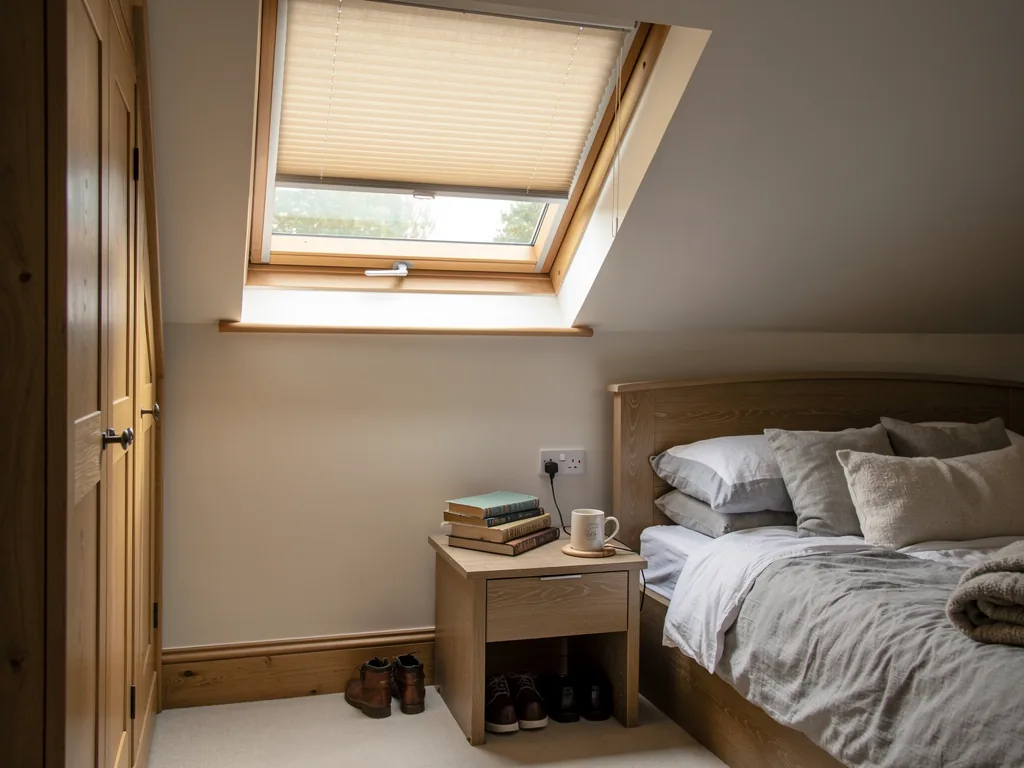
A pleated blind takes the glare out of the day and leaves the room bright. It folds in concertina pleats that can be pulled from the top or the bottom, so you can shade the lower part of the glass and let light in above. This works well in a home office or a landing, where you want brightness without a hot patch on the desk.
A roller blind does a similar job with a smooth fabric, in a range of translucent or opaque weaves. The choice between them is mostly taste. Pleated blinds tend to look softer, and rollers look cleaner. If you want both darkness and softness, some rooms use a pleated blind for the day and a blackout blind for the night.
External awning blinds against heat
A blind inside the glass stops light but not heat, because the sun has already passed through the pane before the blind sees it. An external awning blind sits outside the glass and stops the sun before it enters. For a top-floor room under a south or west slope, it is the more effective answer to summer overheating.
The trade-off is that it is outside. It needs fixing to the window and it is exposed to weather, so it is one to plan at the fitting stage. Our guide to solar control glass shows the other approach, which is to use the glass itself to reduce heat.
Manual, solar or mains control
Blinds and windows can be pulled by hand, run on a small solar panel, or powered from the mains. Each suits a different position and a different budget. A hand-operated blind is the simplest, and for a window within reach it is the sensible default. A window you cannot reach without steps is where a motor is worth the extra cost.
- Manual: a pole or a pull cord, nothing to fail, and the cheapest.
- Solar: a small panel in the frame charges the motor, so there is no cable, but the position has to catch daylight.
- Mains: wired in, reliable, and able to link to a wall switch or a remote, but it needs a cable run before the ceiling is closed.
The cable is the part to plan early. Wiring a mains control into a ceiling that has already been plastered is awkward, so we ask at the survey whether you might want it.
Opening, rain and heat sensors
An electric window can open by itself on a schedule or when the room gets warm. Some include a rain sensor that closes the window when a shower begins. Those are useful in a loft room you are rarely in during the day, a spare room used for storage, or a bathroom where you want steam to leave without remembering to open the window.
They are an add-on rather than a necessity. If you are in the house through the day, a manual window and a good blind will do the job for far less. For a window you can reach from the stairs, a manual handle is hard to beat. We say more on this in our guide to VELUX window cost.
Flashing, collars and the extras you do not see
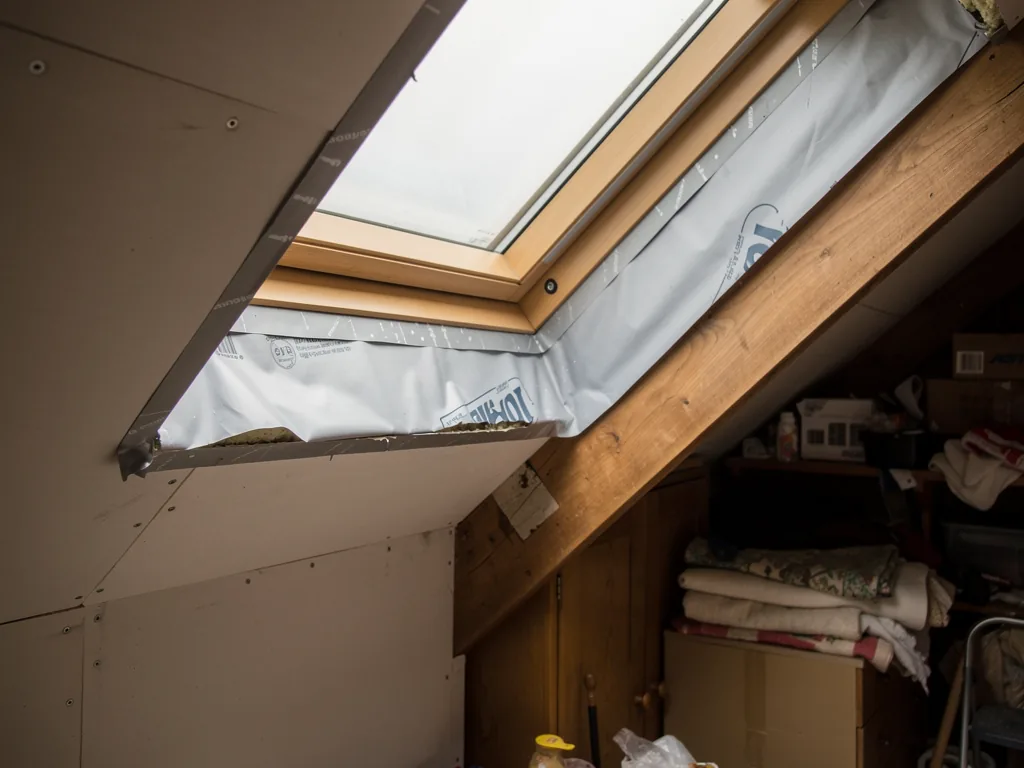
Not every accessory is a thing you look at. The flashing kit that seals the window to your roof covering, the insulation collar that wraps the frame and the vapour control membrane round the lining are all accessories in the maker's list, and they decide whether the window does its job for the long term.
These are the ones we never skip. They are chosen for your roof covering, and we photograph them before the lining closes over them so you have a record. Our guide to roof window flashing goes into the detail.
The main choices side by side
Sorting the options by what each one is for makes the decision less of a muddle. The table is a rough guide to how the main kinds of blind behave, not a specification, and the exact range on offer changes from time to time.
| Blackout | Darkens a bedroom, little else |
|---|---|
| Pleated | Softens daylight, can be set part open |
| Roller | Plain, clean look, easy to wipe |
| Honeycomb | Traps a layer of air, helps with glare and a little with warmth |
| External awning | Stops sun before it warms the glass |
Cords, children and a bedroom ceiling
A loft bedroom is often a child's room, and a loose cord is a risk in any room with a cot or a bed. A pull cord should be short, fixed or tied up out of reach, and a bed or cot should not sit directly under the blind's controls. Poles, cordless pull handles and electric controls take the problem away. If the room is for a young child, say so when we visit, and the quote will lean towards the safer controls.
It helps to think about the room as it will be in a few years, not only as it is now. A nursery becomes a child's bedroom, then a teenager's den, and the window controls should still make sense at each stage. Electric or pole-operated controls are the ones that keep working without any change as the people in the room grow up.
A cord is also what tends to break first on a window you use daily. A pole that clips to the sash and the handle makes a high window easy to work without stretching, and it has nothing to snag.
Steam, condensation and the bathroom blind
A bathroom is the hardest place for any blind. Steam settles on fabric, and a damp blind next to a damp window begins to look tired in a short time. Choose a fabric and a finish that can be wiped, and keep the window open for a few minutes after a shower so the room can dry out. If the glass is misting up regularly, the problem is air movement more than the blind, and a window you can open at the right height helps more than any accessory.
Where a window is set high above a bath or shower tray, it is worth choosing a blind with a pole-operated bar or a motor, because leaning over wet surfaces to reach a cord is not a good idea. Mention the position of the bath or shower when we visit.
In a kitchen under a sloping ceiling the same applies, with the added issue of grease. A roller blind in a wipeable weave copes better than a pleated one with deep folds.
Choosing colour and fabric
The fabric shows from inside the room far more than the window frame does, so it deserves a moment's attention. A pale blind makes a small loft feel larger and reflects daylight deeper into the room. A dark one is better at blocking light and looks heavier, which suits a bedroom but can close in a landing. Patterned fabrics look best in a room that is otherwise plain.
Whatever you choose, look at a sample against the actual lining colour, in the actual room, at the time of day you most use it. A swatch seen under a shop light behaves differently from the same swatch under a sloping ceiling on a grey morning.
How we handle a blind order at the survey
From question to blind on the glass
- AskTell us how the room will be used, and which hours the light is a problem.
- Check the codeWe note each window code and its position on the slope.
- Price the optionsBlind types and controls come onto the quote as lines you can accept or leave.
- Plan the wiringIf any controls are electric, the cable run is agreed before the ceiling is closed.
- Fit and show youAt handover we show you how each blind and control works.
Ordering with the window or adding later
Adding a blind to a window already fitted is easy. The channels clip into the frame, and the work takes minutes. The reasons to order with the window are practical rather than technical: the colour of the lining and the blind are chosen together, any wiring is done before the plastering, and the delivery arrives in one go.
Waiting makes sense if you are unsure how the room will be used, or if a tight budget needs to be spread. In that case we leave a clear note on the quote saying which window codes you have, so that ordering later is a simple step.
What we would put on the list
For a bedroom: a blackout blind, with a pleated blind in addition if you want the day to feel soft. For an office: a pleated or roller blind. For a top-floor room facing south or west: an external awning blind if you can afford it, and a manual blind inside if you cannot. For a bathroom: a moisture-resistant finish and a way to open the window easily.
We discuss all of this at the free survey, once we can see the room and the slope. You can read about the job as a whole on our VELUX window installation page, and the form below books a survey.