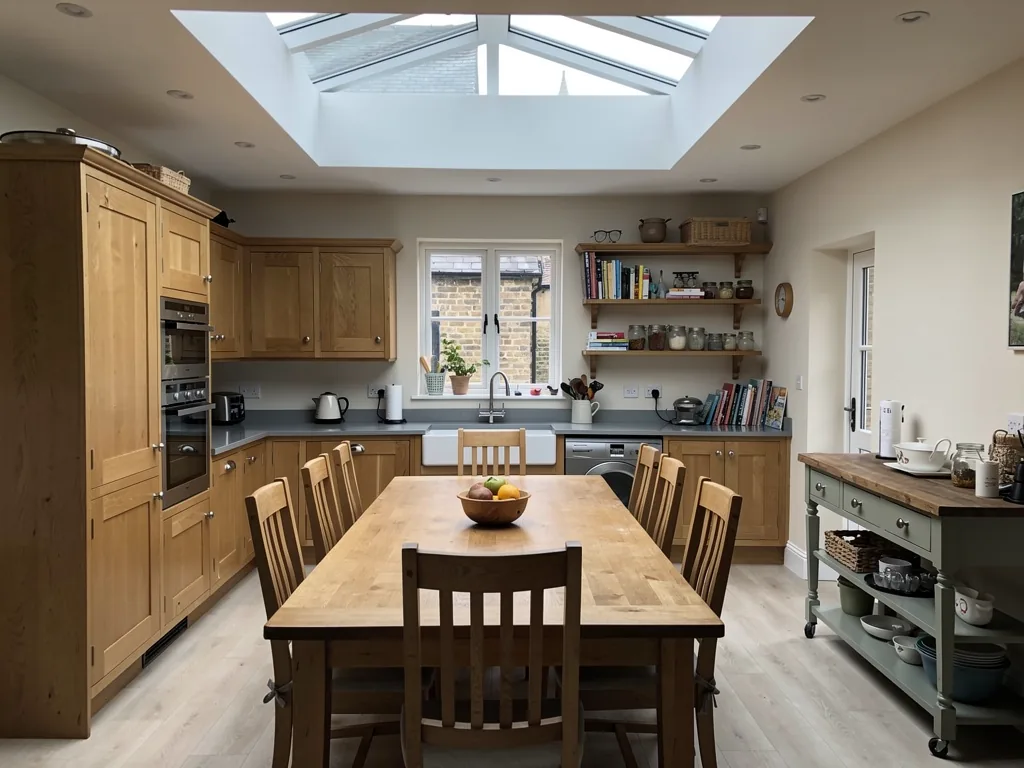
Roof lantern cost is one of the first things people ask about, and one of the hardest to answer from a distance. The lantern itself is a product with a list price, but the job of fitting it is shaped by your roof, your room and the way the extension was built. That is why we price every lantern from a survey rather than a table, and why a quote that does not break the work into its parts is hard to compare with anything.
Below are the parts of a lantern job that move the price, in the order they appear on a quote. It will not give you a figure, because any figure without a survey would be a guess. It will tell you what you are paying for, and what questions to ask when you compare quotes.
The lantern: size, shape and frame
The biggest single item is the lantern unit. Its price follows its size, its shape and what it is made from. A standard rectangular lantern from a maker's range costs less than a made-to-measure one, and a simple pyramid costs less than a long lantern with a ridge and several glazing bars. Larger lanterns need stronger bars and bigger sealed units, so the price climbs faster than the size.
The frame material comes next. Aluminium lanterns use thermally broken profiles and give slimmer bars, which is why they suit larger lanterns and a more modern look. uPVC lanterns cost less for the same size and perform well on small and medium sizes. Colour can matter too: a standard white or grey costs less than a special colour, and a different colour inside and out adds a little more.
Our roof lantern sizes guide explains how to relate the lantern to the room, and the aluminium or uPVC guide compares the two frames.
The glazing
Every lantern we fit uses sealed units with a low-emissivity coating and a gas-filled cavity. Within that, the choices that affect the price are the number of panes, the type of glass and any coatings. Triple glazing costs more than double but is warmer and quieter in rain. Solar control glass costs more but keeps a south or west-facing room from overheating. A self-cleaning coating on the outer pane adds a little and saves on cleaning.
We specify laminated glass for the inner pane on overhead glazing, so that if it is ever broken it holds together. That is part of our standard specification rather than an extra, and it appears on the quote so you can see it is there.
| Glazing choice | Effect on price | What it buys |
|---|---|---|
| Double glazed, low-E, gas-filled | Standard | Meets the thermal standard for rooflights |
| Triple glazed | Higher | Warmer and quieter, especially in rain |
| Solar control | Higher | Less heat build-up in sunny rooms |
| Self-cleaning outer pane | Slightly higher | Rain washes the glass more evenly |
The upstand and the opening
The lantern sits on an upstand, a raised kerb at least 150mm above the finished roof. Building it properly takes timber, rigid insulation and the roof covering dressed up and over it. Some lanterns come with a factory-made insulated upstand, which costs more as a product but saves time on site. On an existing roof we often build the kerb on site to suit the joists that are there.
Forming the opening is the structural part of the job. Every joist cut to make room for the lantern has to be carried by new trimmers. An opening that lines up with the existing joists is quicker and costs less. One that crosses several joists, or sits in an awkward position over a beam, takes more work. On a new extension, a builder who frames the opening to the lantern's exact size saves cost later.
More detail on kerbs and heights is in our guide to the roof lantern upstand.
The roof around it
A lantern is only as good as the roof it sits in. If the flat roof is newer rubber or fibreglass in good condition, it can be cut and re-formed round the upstand cleanly. If it is old felt, cracked or close to the end of its life, cutting a hole in it and patching round a new lantern rarely lasts. In that case the quote will show the option of re-covering the roof at the same time.
That can make the total feel larger, but it is usually the cheaper choice over the life of the roof. Doing both together means one set of access, one weathering detail round the upstand and one guarantee, rather than coming back in a few years to strip a failed roof around a new lantern.
Access, protection and waste
Getting materials and people onto a flat roof safely is part of the job. On a single-storey extension with good garden access, a ladder and a working platform may be all it takes. Where the roof is higher, where the garden is reached only through the house, or where the lantern is large and heavy, a scaffold or a tower may be needed. That is a separate line on the quote so you can see what it adds.
Protecting the house, clearing up as we go and taking the waste away are part of how we work, not extras. They are built into every quote and listed so you know they are included.
Inside: the reveal, lighting and decorating
From the room you see the reveal, the lined box between the ceiling and the lantern frame, more than the lantern itself. Insulating, boarding and plastering it to a smooth finish is part of a proper job. Splayed reveals, which widen towards the room, take a little more work than straight ones but spread the light further.
Lighting is worth deciding early. LED strips hidden in the reveal or downlights round the opening are far easier to wire before the ceiling is closed. Decorating is optional: some people want the room finished and painted, others prefer to do it themselves. Each of these sits on its own line so you can choose.
Planning and Building Regulations
Most lanterns rise more than 150mm above the roof plane, which is the height limit for rooflights under permitted development. So a lantern added to an existing roof may need a planning application or a confirmation from the council, and that has a fee of its own. A lantern built as part of a new extension is usually assessed with the extension. Listed buildings always need consent.
Building Regulations approval is needed for the structural opening and for the lantern as a controlled fitting. The building control fee is part of the cost of the job, and we arrange the application and inspections for you. Our answer on whether roof lanterns need planning permission covers the planning side in more detail.
Replacing an old lantern
Replacing an existing lantern is priced differently from fitting a new one. There is no new opening to cut and trim, so the structural part of the job is usually smaller. Against that, the old lantern has to be taken out carefully and disposed of, and the kerb it sat on has to be checked. Older kerbs were often built low, with little or no insulation, and setting a new lantern on one of those carries the old problems straight over to the new glass.
Where the kerb is sound and tall enough, we insulate it, re-weather it and fit the new lantern to it. Where it is not, we rebuild it, which adds to the cost but is the only way to get the warmth and dryness a new lantern should give. If the frame of the old lantern is fine and only the sealed units have misted, replacing the glass alone costs far less than a whole new lantern. Our misted and failed rooflights service covers that.
A whole replacement lantern is a controlled fitting under Building Regulations, so the building control side is part of that job too, just as it is for a new installation.
The costs after fitting
A lantern costs very little to keep once it is in. The glass benefits from a wash a few times a year, more often under trees, and the gutters round the extension should be kept clear so water drains away from the upstand. Neither needs special equipment, though cleaning the outside of a lantern safely may mean a ladder platform or a long-reach brush. Our answer on how to clean a roof lantern has the detail.
Heating is the other running cost people ask about. Modern lantern glazing loses far less heat than the polycarbonate roofs fitted to many older extensions, and a properly insulated upstand removes the cold edge that used to form round the opening. How that shows up on your bills depends on the room, the rest of the house and how you heat it, so we do not put a figure on it. What we can say is that the glazing we fit meets the current thermal standard for rooflights, and the upstand detail is designed so the lantern does not become the coldest part of the room.
Blinds are the other common addition after the event. Fitted blinds made for a particular lantern are available for many models, but they are easier and usually cheaper to order with the lantern than to add later, because the maker can supply them to the exact glass sizes. If you think you might want shading on summer afternoons, mention it at the survey so it can be priced as an option.
Opening vents and electric controls add moving parts. They are reliable, but they are worth including in your thinking when you weigh up the options at the survey.
How to compare quotes
When you have more than one quote, compare them line by line rather than by the total. A lower price can mean a thinner upstand, a cheaper glazing specification, no reveal finishing, or a roof patched rather than re-covered. None of that shows on the day, but all of it shows in the years after.
Questions worth asking any installer:
- What is the glazing specification, pane by pane?
- How high is the upstand, and how is it insulated?
- Is the reveal plastered, and is decorating included?
- Who handles Building Control, and is the fee included?
- What happens to the roof covering around the lantern?
- What does the workmanship guarantee cover, and for how long?
Our quotes answer each of those in writing, with a plan for each day of the fit. The survey is free, and you can book one with the form below or read more on our roof lantern installation page.