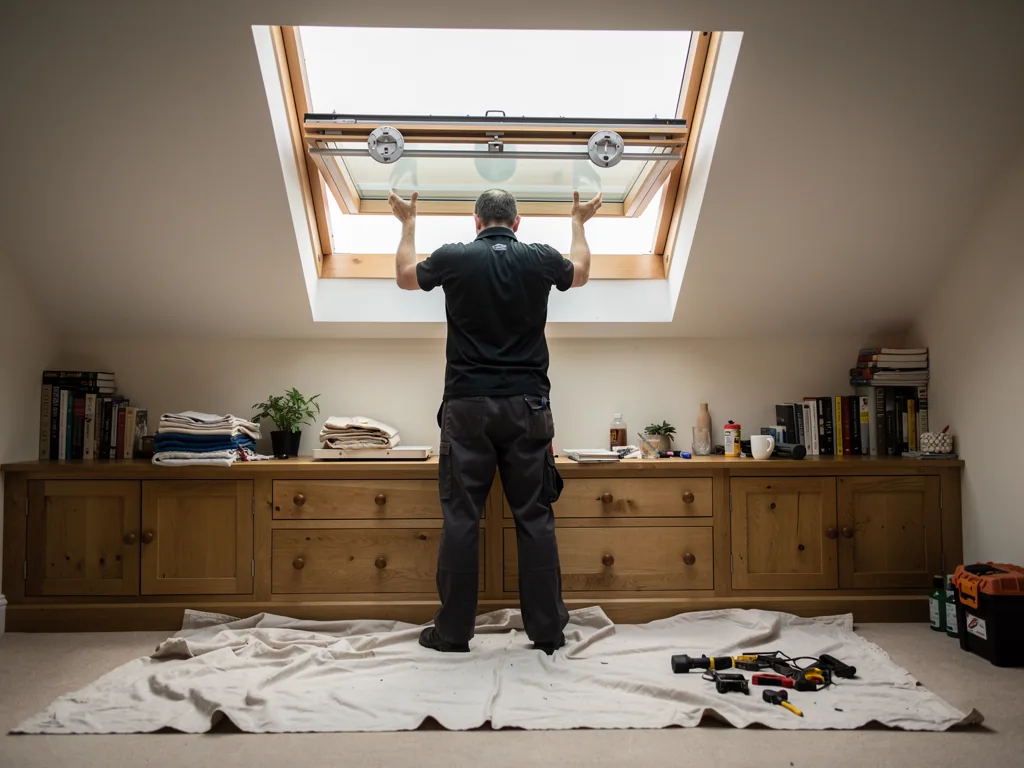
Once you know a rooflight's glass has failed, a second decision arrives quickly. Do you replace the sealed unit and keep the frame, or take out the whole rooflight and start again? Firms will often steer you towards whichever they find easier. The better way to decide is to look at the frame and the kerb it sits on, and let them make the choice for you.
In practice the two routes differ in what is done on the roof, in what points to one or the other, and in the paperwork that follows. If you are standing under a hazed rooflight wondering how much of it really has to go, the answer depends on the frame and the kerb as much as the glass.
What a sealed unit is, and what it is not
A sealed unit is the pair of panes, the spacer between them and the edge seal that keeps the gap dry. It is a manufactured part that sits in a rebate in the frame, held by gaskets, beads or sealant. The frame is a separate thing. It carries the glass, meets the roof and is fixed to the upstand.
That separation is what makes a glass-only job possible. If the unit can be lifted out and a new one dropped into the same rebate, the rest of the rooflight is left alone. If the unit is bonded into the frame, or the frame itself is the problem, the separation is not there and the job grows.
Signs that the glass alone will do
A new unit in the existing frame is the right call when the frame is still a good thing to build on. In practice that means checking a handful of conditions on the roof itself.
A frame worth keeping looks like this
- Square and flat, with no twist when you sight along it
- No cracks, soft timber, corrosion or brittle plastic
- Dry on the inside, with no staining where it meets the upstand
- Weathered into the roof with no gaps at the corners
- A rebate deep enough to take a unit of modern thickness
The last point deserves attention. Older frames were made for thinner glass, and a modern unit with a low-emissivity coating, a gas fill and a laminated inner pane can be thicker. If it will not sit in the rebate, the frame is the limit, not the glass.
Signs that the whole rooflight should go
A whole new rooflight is the better answer when the frame has stopped doing its job. Frames fail in a few familiar ways, and they are usually plain on a close look.
| Cracked or brittle plastic | It will not hold new glass or a new seal for long |
|---|---|
| Corroded metal at the joints | Water already passes the weathering at that point |
| Soft or stained timber | Damp has been getting in, and the kerb needs opening up |
| Bowed or lozenged shape | New glass would be under strain from the first week |
| Corners letting water through | The weathering is the issue, not the pane |
None of this is cosmetic. A new unit in a frame that is already moving will fail the same way the old one did, and the haze comes back.
The upstand underneath
Whichever route you take, the kerb under the rooflight matters. A flat rooflight is meant to sit on an insulated kerb standing 150mm or more clear of the finished roof, and many older ones were built lower and with little insulation. A cold, low kerb leaves a ring of condensation just inside the frame, which looks like a glass problem and is not.
If we find that, it is shown separately on the quote. It is a reason to prefer the whole-rooflight route, because lifting the frame off is the moment the kerb can be raised and insulated properly. The survey for misted and failed rooflights covers exactly these checks on the frame and kerb.
Size, shape and the fit to the opening
A replacement unit is made to the exact size of the rebate, so measurements are taken with care. We record the width, the length and the thickness of the glass, and we check that the frame is square, because a unit that is a few millimetres out will not seat.
Odd shapes are possible but take longer to make. A round, arched or angled unit is more of a one-off than a rectangle, and the lead time stretches with it. Where a shape is awkward and the frame has little time left, a whole new rooflight in a standard size can be the simpler route as well as the better one.

Several failed units in one roof
If more than one rooflight in the house has misted, look at the pattern. Units fitted at the same time often reach the end of their lives at the same time, and what ties them together may be a make, a batch or a way of fixing. That is useful, because it tells you what the rest are likely to do.
Where several rooflights share the same fault, the frames are usually the same age too. It is worth looking at all of them at one visit and deciding the plan together, rather than replacing one pane and finding another gone next season.
What changes in the rules
The two routes are treated differently by the Building Regulations. A sealed glass unit alone is not notifiable. A new frame with new glass is a controlled fitting, so it must be notified, and we arrange the Building Control notification for it.
A whole new rooflight in existing homes is also expected to meet the Part L figure for rooflights, 2.2 W/m²K. That is usually met by a modern double glazed unit in a thermally sensible frame, and it is one reason a very old frame is not worth keeping. Our short answer on whether replacing a rooflight is notifiable sets it out simply.
What each route means for your day
A glass-only job is shorter. The room below is protected, the old unit is taken out, the new one is bedded in and the area is cleared. Most of the time is spent on measuring beforehand, not on the roof itself.
A whole rooflight takes longer, because the frame, the kerb and the weathering all come into play. Each evening the roof is covered over so that rain cannot reach the room, and you are told what each day involves before it begins.
The shape of a whole rooflight swap
- Protect and open upFloors covered, old frame lifted off its upstand.
- Check and correctKerb examined, then raised or insulated if it needs it.
- Fit and weatherNew rooflight set, roof covering dressed up and round it.
- Finish and hand overReveal finished inside, waste cleared, paperwork walked through.
Old units and what they carried
Rooflights fitted before the recent thermal rules often carry glass that was never very good at keeping heat in. Early double glazed units had plain air in the gap and no coating on the glass, and even before they misted they were a weak point in the roof.
That matters when deciding between the routes. If the frame is good, a new unit with a low-emissivity coating and a gas fill brings the glazing up to a modern standard inside the frame you already have. If the frame is poor, you are replacing something that was not performing well to begin with, and a whole new rooflight is the more sensible spend.
When the choice is close
Some rooflights sit between the two routes: a frame that is sound today but ageing, with glass that has just failed. Here the decision turns on how long you plan to stay and how much disturbance you would accept a second time.
New glass now buys you clear light at the lowest outlay, and the frame can be replaced later if it needs it. A whole rooflight now costs more, but it settles the question for good and avoids a second visit to the same opening. We set out both on the quote when it is close, and leave the choice with you.
A side-by-side view
Laid out together, the two routes look like this. The point is not that one beats the other, but that each fits a different frame.
| What is replaced | The sealed unit only, or a complete frame with its glass |
|---|---|
| What stays | Frame, upstand and weathering, or nothing of the old rooflight |
| Time on the roof | Short for glass alone, longer when a frame and kerb are dealt with |
| Building Regulations | Not notifiable for glass alone; notifiable for the whole rooflight |
| Best suited to | A frame that is square, dry and sound, or one that is no longer sound |
Warranties, guarantees and what you are given
Either route should end with paper in your hand. For a new sealed unit that means the product details of the glass and the maker's warranty on it. For a whole rooflight it means the same, for the frame as well, together with the Building Control paperwork.
Our workmanship comes with a 10-year guarantee in both cases. We walk you through the finished work at handover, and give you photographs of the hidden parts, such as the upstand and membrane, taken before they were covered. Those photographs are worth keeping with the house file.
Questions to put to the firm at the survey
Whoever surveys the rooflight should be able to answer a few direct questions, and the answers tell you whether the choice has been thought through.
Worth asking out loud
- Why is the glass alone enough here, or why is it not?
- Is the new unit thicker than the old, and will it fit the rebate?
- What did you find on the upstand and the roof covering?
- Does the quote include any notification under the Building Regulations?
- What are the makers' warranties on the new glass or rooflight?
A firm that has looked closely will have specific answers. A firm that has not will tend to talk in general terms about glass.
Cost, and how to ask for the right quote
The glass-only route usually costs less, because it leaves the frame, kerb and roof covering alone. A whole rooflight costs more and gives a new frame and new weathering. Neither is automatically the better buy; the right one is the one that suits the frame you have. Our guide to what it costs to sort a misted rooflight looks at the parts of the cost in more detail.
Ask any firm quoting you to say why they chose the route they did, and what they found on the frame. A good quote answers that. Ours does, itemised cost by cost, and the survey is free.