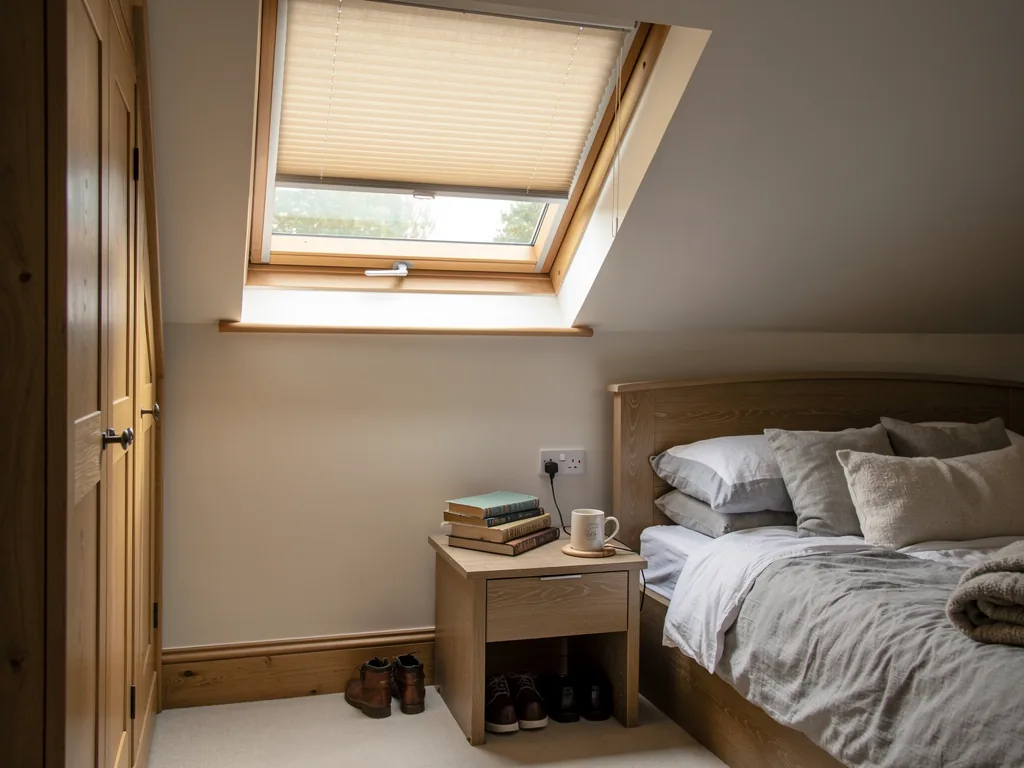
A rooflight takes in the sun from above, where it is strongest. On a bright afternoon a south or west-facing room under a large expanse of glass can grow uncomfortably warm well before the heating has been off for long. Solar control glass is the glazing answer to that problem, and it is often chosen without much explanation of what it changes.
This guide explains how it works, what you give up in return, how it compares with blinds and with ordinary low-E glass, and how to decide whether your room needs it.
What solar control glass does
Ordinary glass lets nearly all the sun's energy through. Solar control glass carries a fine metallic coating that reflects or absorbs part of the sun's heat before it reaches the room. Visible light still passes, but less of it, and less of the infrared warmth that travels with it.
The coating sits on one of the surfaces inside the sealed unit, where it is protected from weather and cleaning. It is a separate job from insulation, though the two coatings can be combined in one unit, so a single pane may help keep warmth in during winter and keep the sun's heat out in summer.
How it differs from low-E glass
Low-emissivity glass is aimed at the heat the room itself gives off. Its coating reflects that heat back inside, so the room holds its warmth. Solar control glass is aimed at heat arriving from outside. The two coatings work on different parts of the spectrum and, in a good unit, are chosen together.
Our guide to low-E glass on a rooflight covers the insulating side. Think of low-E as a winter coating and solar control as a summer one, with a good unit managing both.
| Coating | Heat it targets | Main benefit |
|---|---|---|
| Low-E | Heat from inside the room | Keeps warmth in and the inner pane warm |
| Solar control | Heat from the sun | Reduces heat gain on bright days |
| Both in one unit | Heat in both directions | A steadier room across the seasons |
Reading the numbers
The measure of how much solar energy gets through is the g-value, also called the solar factor. It is a figure between nought and one, and a lower g-value means less of the sun's heat enters. Light transmission is a separate figure, showing how much visible light passes.
A good solar control unit gives you a low g-value while keeping the light transmission reasonably high, but there is always a trade-off between the two. A very low g-value usually means a darker or more reflective glass. Ask for both figures on the data sheet and compare them with the clear alternative, so you can see what is being exchanged.
Which roofs and rooms benefit
Which way the glass faces decides most of it. A rooflight facing south or west takes the afternoon sun and tends to build up heat. A north-facing slope rarely needs the coating. Flat rooflights and lanterns face the sky, so they take the sun at its highest and most direct, which is why they often benefit even when no wall faces south.
The room matters too. A kitchen-diner extension with bifold doors and a large lantern has a great deal of glass. A top-floor bedroom under a roof window is shut in under the roof, so heat has nowhere to go. Our answer on whether rooflights make rooms hot in summer looks at the problem from the other side.
Worth considering for
- A large lantern or flat rooflight on an extension that faces south or west
- A loft bedroom or office under a south-facing roof slope
- A room with several glazed surfaces, such as doors as well as a rooflight
- A house with no shade from trees or neighbouring roofs
- A room where cooling matters, such as a nursery or a workspace
What you give up
Solar control glass admits less sun in winter as well as in summer. A south-facing room that enjoys free warmth on a bright January afternoon will get a little less of it. For a family room that is lit and heated for much of the day, that loss can be acceptable. For a conservatory-like space where you want to bask, it may not be.
The glass can also look different. Some coatings give a faint tint, a slight reflection from outside or a cooler tone to the light inside. It varies by maker and by grade, and the effect is easier to judge with a sample in your hand than from a leaflet. We bring samples to the survey for that reason, and you can look at them in the room itself.
Blinds and glass working together
Blinds are the other way to control the sun, and the two are not rivals. A blind stops the sun after it has passed through the glass, so the heat is already inside the room. Solar control glass stops some of it before it arrives. An external blind is the most effective of all but is rarely practical on a roof.
For many rooms the sensible answer is a mix. Choose a modest solar control build for the worst orientation, and add an internal blind you can close when the sun is brightest. A blind lets you decide, hour by hour, while glass makes the decision once. On a roof window, a pleated or honeycomb blind in the side channels is a neat fit, and our team can supply one with the window.
Glare, furniture and fabrics
Heat is not the only thing the sun brings. A bright patch moving across a screen, a table or a sofa can be as annoying as a warm room, and strong light fades fabrics, wood floors and pictures over time. Solar control glass cuts some of the ultraviolet and visible light that does this, though it does not stop it altogether.
If glare is the main complaint, a lower light transmission helps, and so does the position of the glass. Ask at the survey where the patch of sun lands at different times of day. A sample held up in the room will show you whether a coating softens the light enough to matter, or whether a blind is the better answer for that spot.
A south-facing extension in July
Picture a brick kitchen extension on the back of a terrace in York, with a lantern above the dining table and glazed doors onto the garden. From midday the sun comes over the roof, through the lantern, and settles on the table and the floor. The doors add more. By late afternoon the room is warm, the cooker has not even been lit, and the family has retreated to the front room.
A solar control coating in the lantern takes the sharpest edge off that heat, and a blind in the lantern deals with the remaining hours. An opening vent at the top lets the warm air go. None of the three does the whole job alone, but together they change the room from one you avoid in summer to one you use.
Swapping the glass in a rooflight you already have
If your existing rooflight is sound but overheats, the glass can sometimes be replaced alone. A new sealed unit with a solar coating goes into the existing frame, which keeps the work smaller and the cost down. Replacing a sealed unit by itself is not notifiable under the Building Regulations, though a whole replacement rooflight, frame and glass, is.
The frame has to be in good order and deep enough to take the new unit. Older frames were often built for thinner double glazing, so we measure the rebate before we promise anything. Where the frame is tired, a whole new rooflight on an insulated upstand is the better route, and we handle the notification for you. Our guide on a new sealed unit or a whole new rooflight sets out how to choose.
Questions to ask before you choose
Whoever supplies your glass, a short list of questions keeps the choice clear.
- What is the g-value, and what is the light transmission, for this exact build?
- Is the solar coating combined with a low-E coating in the same unit?
- Does the coating change the colour of the view or the light?
- What is the whole-unit U-value at my size?
- Can I see a sample in my own room?
The answers should appear in your written quote with the glazing named pane by pane. That is the easiest way to compare it with another quote, and it gives you the details to hand when the makers' warranties arrive at handover.
Pairing it with ventilation
Heat that builds up under a roof needs a way out. An opening rooflight at the top of the room lets warm air rise and leave, drawing cooler air in lower down. A window with a night vent setting allows a trickle of air while you are out. These help whether or not you choose solar control glass, and in some rooms they do as much as the coating.
Electric opening and rain sensors are worth considering where the rooflight is out of reach. They let you open the glass at the top of a tall room without a pole or a ladder. The glazing and the opener should be chosen together, because a heavier build changes how the window works.
Combining it with the thermal build
Solar control glass can be made as double or triple glazing. A triple unit with a solar coating will keep the sun's heat out and the room's warmth in, though it will be heavier and cut the light a little further. Our guide to double or triple glazed rooflights looks at that choice.
Whichever you pick, the glass has to meet the thermal limit for its type under Part L 2021: 2.2 W/m²K for a rooflight, or 1.4 W/m²K or Band B for a roof window. Most solar control units meet it easily, but check the whole-unit U-value as well as the g-value, which is the point of our rooflight U-values explained guide.
Choosing it at the survey
The decision is easiest in the room. We look at which way the glass faces, how much shade it gets and how the room is used, then offer a clear option and a solar control option as separate lines on the written quote. If you are replacing an existing rooflight, we can also look at how it behaves in the afternoon sun before recommending anything.
The work around the glass matters just as much as the glass itself. The upstand is insulated and photographed, the floors and stairs are covered, and the roof is closed against the weather each day until the job is finished. The handover includes the product details, the makers' warranties and our 10-year workmanship guarantee. For the wider subject, see energy efficient rooflights.